- Products
- Advanced Nano technology creates realistic, sharp, and sophisticated patterns.
- Striking veining blends artistry and nature for a luxurious touch.
- Timeless elegance with minimalist yet captivating designs.
- Crystalline Silica Free represents one of the most revolutionary advancements and the latest trends in the premium engineered quartz stone manufacturing industry.
- Pre-fabricated quartz pieces designed for convenience and beauty, reflecting each owner’s unique style and refined taste
- Customized quartz pieces precisely crafted to fit your project, ideal for countertops, vanities, and bespoke applications
- Applications
- Timeless Elegance & Durability
- Sophistication in Every Detail
- Serenity & Ultimate Comfort
- Your Personal Home Spa
- Projects
- News & Updates
- Discover Us
- Catalog
- Contact us


Quartz countertops for apartment projects: 3 main challenges.
16:33 | 06/10/2026
In apartment projects, engineered quartz countertops are often considered due to their relatively stable ability to control color, patterns, and production specifications. For apartment projects, material selection is not only related to aesthetics but also involves considerations of volume, consistency among units, fabrication, schedule, and quality control.
The following article focuses on key considerations when using engineered quartz for kitchen countertops in apartment projects, from material selection to production batch management, fabrication, and inspection and acceptance.
Why is engineered quartz often considered for apartment kitchen countertops?
Engineered quartz is manufactured according to a defined production control process. Depending on the product line, color and patterns can be maintained with relatively consistent appearance between slabs, while the surface has low porosity and is convenient for cleaning during daily use.
For apartment projects, these characteristics can support the standardization of materials across multiple apartments with similar designs. Contractors can standardize the stone code, thickness, edge profile, and fabrication specifications from the beginning instead of handling each apartment separately.
The large-volume challenge from quantity takeoff to product standardization
Quantity takeoff by apartment type
Kitchen countertops can be designed in various configurations, such as: Single-wall kitchens; L-shaped kitchens; U-shaped kitchens; Kitchens with islands; Kitchens combined with dining tables or bar counters.
Instead of only estimating the total square meters of stone required, it is advisable to prepare a quantity takeoff table for each apartment type and countertop specification. This approach helps the parties more clearly determine: Total stone area required; Estimated number of slabs; Specifications of each fabricated component,...
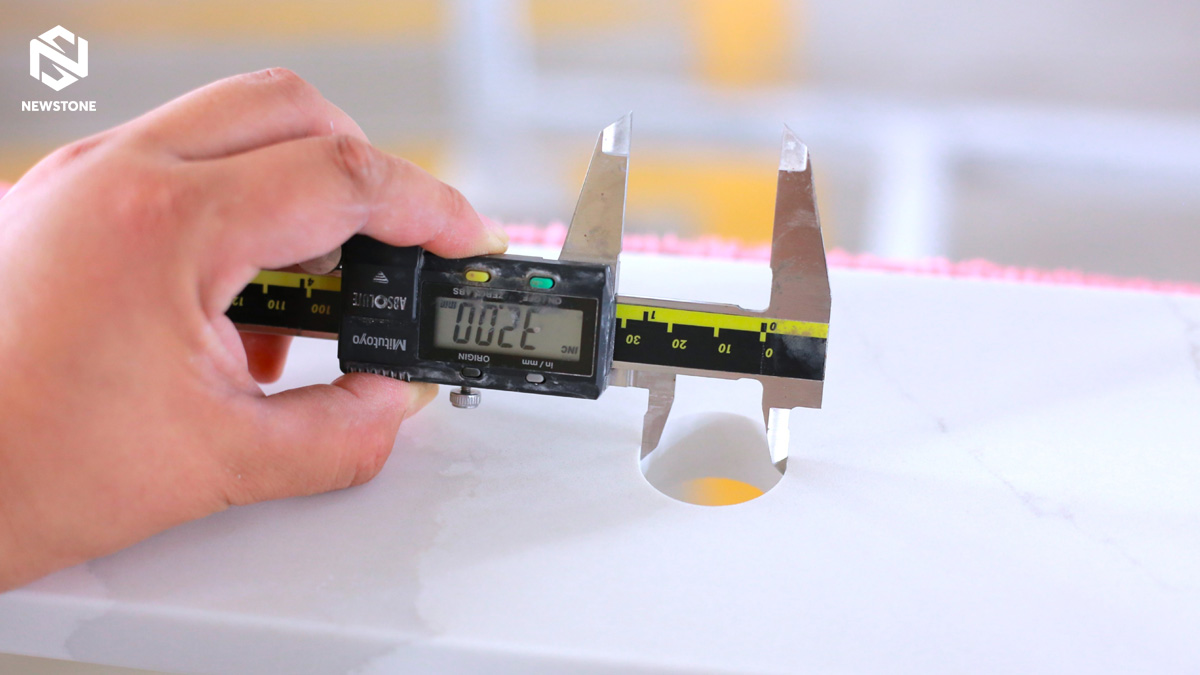
The waste rate may vary depending on slab dimensions, countertop shape, vein-matching requirements, sink cutout locations, and cutting plans. Therefore, instead of applying a fixed rate to every project, the parties should agree on the calculation method and contingency allowance in the supply documents.
Standardizing stone codes, thickness, edge profiles, and cutout locations
A project with hundreds of apartments will involve multiple fabrication steps if each apartment uses a different configuration.
Therefore, the following should be standardized in advance: Stone code; Thickness; Edge profile; Dimensions; Locations of joints.
Limiting the project to one or two edge profiles and standardizing the cutout dimensions according to the selected equipment can help reduce complexity during fabrication, inspection, and installation.
Controlling color and stone patterns across hundreds of apartments
One of the issues that should be considered when supplying engineered quartz for apartment projects is consistency in color and patterns.
Production batch management
To reduce the risk of variation between different areas of the project, the owner and supplier may consider finalizing the total expected volume as early as possible. Color and patterns should be agreed upon from the sample approval stage.
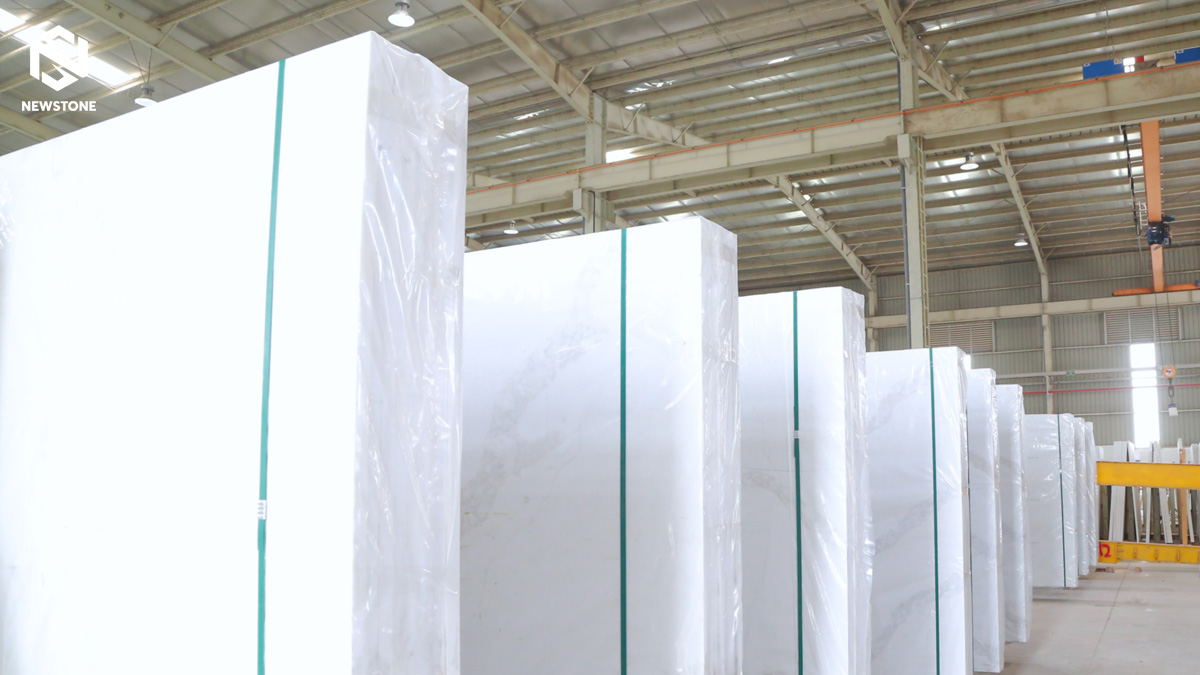
Approving a standard sample before mass production
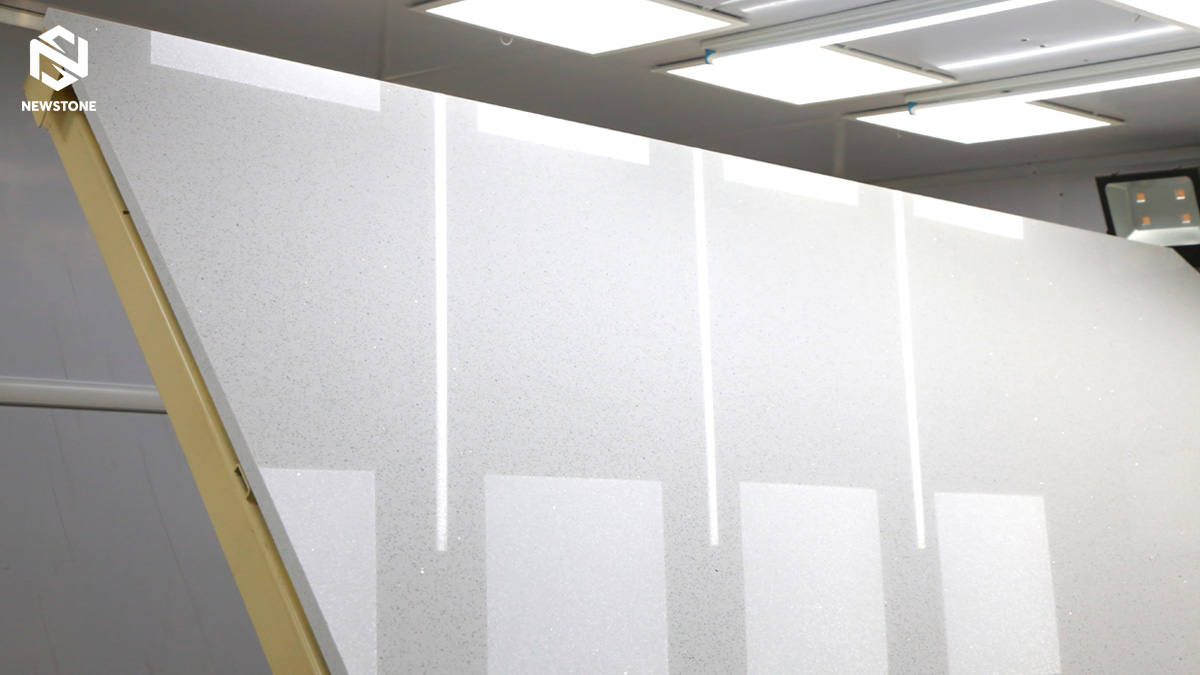
The standard sample is an important basis for the parties to agree on the product's color, base, vein density, and overall appearance.
For veined stone products, the sample should be viewed under different lighting conditions and in combination with the actual materials in the kitchen space, such as cabinets, flooring, walls, and appliances.
Scheduling: coordinating engineered quartz countertops with kitchen cabinets and finishing works
Countertops are directly related to kitchen cabinets, appliances, electrical and plumbing systems, and other finishing works. Therefore, fabrication and installation schedules should not be separated from the overall apartment construction schedule.
A typical workflow can be implemented as follows:
| Stage | Main work | Coordination requirements |
|---|---|---|
| 1. Material and sample approval | Approve stone code, thickness, edge profile, and standard sample | Confirm early so the supplier can proactively plan production |
| 2. Site survey and measurement | Take actual measurements after the kitchen cabinets or cabinet frames are completed | Check discrepancies between drawings and actual site conditions |
| 3. Fabrication | Cutting, edge polishing, cooktop and sink cutouts | Confirm appliance dimensions before fabrication |
| 4. Quality inspection | Check dimensions, surface, edges, and cutout locations | Compare against drawings and acceptance criteria |
| 5. Transportation and installation | Delivery and installation by area | Coordinate freight elevators, floor protection, and corridors |
| 6. Inspection and acceptance | Post-installation inspection | Record and address items requiring finishing |
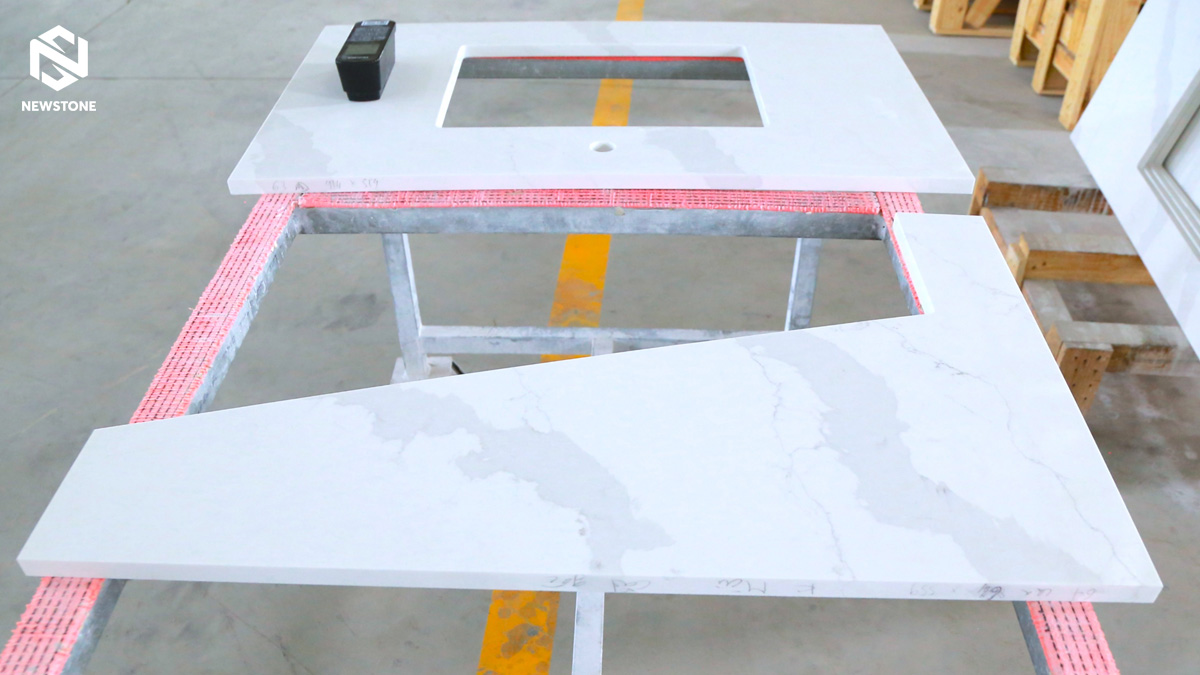
Criteria for evaluating an engineered quartz countertop supplier for apartment projects
When selecting an engineered quartz supplier for a project, owners and contractors can simultaneously consider material, production, fabrication, and schedule management capabilities.
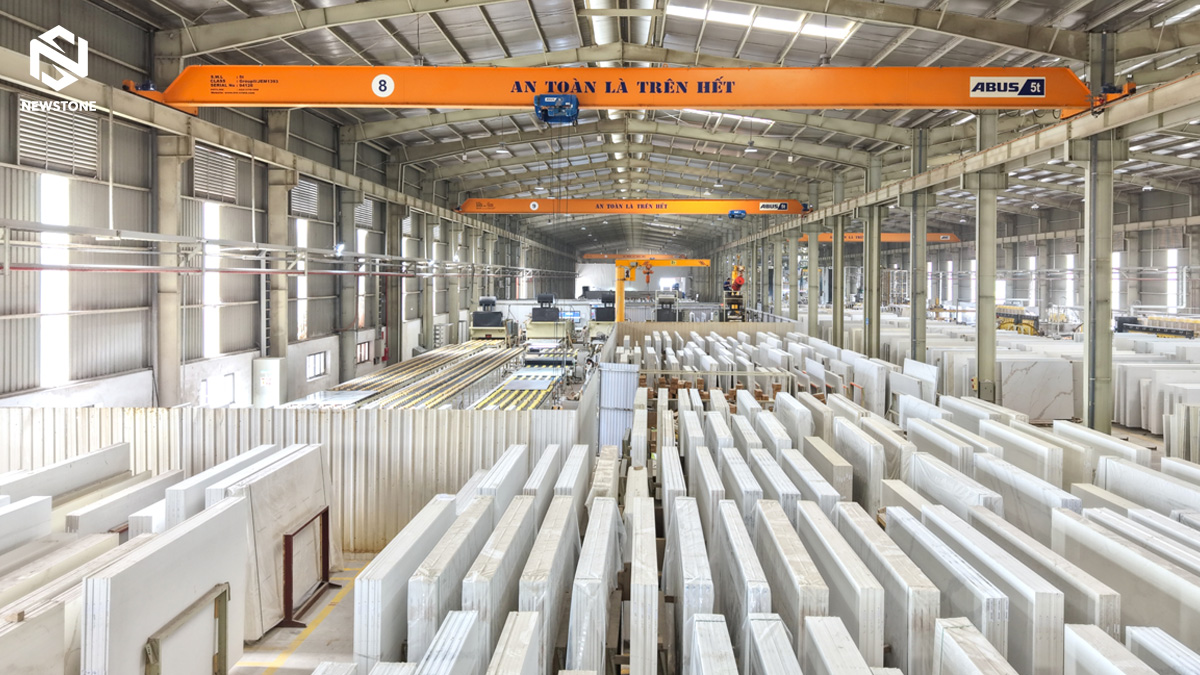
When selecting an engineered quartz countertop supplier for an apartment project, owners and contractors should simultaneously consider material quality, production capacity, fabrication capabilities, and the ability to meet the required schedule. The supplier should have clear technical documentation, product documents, and warranty policies; at the same time, the supplier should be capable of handling large volumes and maintaining consistency between deliveries. In addition, the supplier's finishing capabilities and experience in implementing similar projects should be evaluated.
Frequently asked questions about engineered quartz countertops for apartment projects
What thickness should be selected for engineered quartz countertops in apartment projects?
Common thicknesses may include 20 mm and 30 mm, depending on the product line and design requirements. The appropriate selection also depends on the kitchen cabinet structure, edge profile, aesthetic requirements, fabrication method, and the manufacturer's technical recommendations.
How can color and pattern variations between apartments be minimized?
Production batch management can be combined with standard sample approval.
How does engineered quartz perform under heat?
Engineered quartz has limitations regarding exposure to high temperatures due to the material's composition and binder content. Pots or pans immediately removed from a heat source should not be placed directly on the stone surface. A trivet should be used, and the manufacturer's usage instructions should be followed.
Conclusion
Engineered quartz countertops for apartment projects are not simply a matter of selecting colors and materials. For projects involving large quantities, supply efficiency depends on coordination among design, quantity takeoff, material standardization, production batch management, fabrication, delivery, and inspection and acceptance.
If you are an owner, contractor, or design firm looking for an engineered quartz supplier for an apartment project, NewStone can discuss material requirements, product samples, estimated quantities, and supply solutions suitable for the actual project schedule.
New Stone Technology Joint Stock Company
Hotline: +84 210 3992 888
Address: Lot D3-1, Trung Ha Industrial Park, Tam Nong Commune, Phu Tho Province, Vietnam.
Website: https://newstone.com.vn/
Fanpage: https://www.facebook.com/NEWSTONEJSC
Featured Products

Splendor Product Code: NQ9034

Luxor Product Code: NP2000

Venatino Product Code: NQ8000

Grand Taj Sparkle Product Code: NQ9025

Lagos Product Code: NQ9035

Carrara Blanco Product Code: NQ6003

Black Carrara Product Code: NQ6005

Noreian Product Code: NQ6013

Mysteri Product Code: NQ8003

Mirario Emar Product Code: NQ8007

Calacatta Brook Product Code: NQ8015

Calacatta Gold Product Code: NQ9001

Juno Product Code: NQ9038

Roma Product Code: NZ5900

Milano Product Code: NZ5901

Neapolis Product Code: NZ5902

Florentia Product Code: NZ5903

Agusta Product Code: NZ5904

Lusso Gold Product Code: NQ8011

Lusso Classic Product Code: NQ8010

Leonardo Product Code: NQ8012

Tuscan Dream Product Code: NP2001

Arabescato Gold Product Code: NP2021

Garnet Product Code: NP2022

Darmaso Product Code: NP2024

Cristallo Product Code: NP2025

Calestial Product Code: NP2026
Featured Articles

Sign up for product consultation
Please leave your information, we will contact you immediately.